How to Convert WEBP to JPG on Windows & Mac
Updated August 31, 2026
WEBP is the format websites serve images in, because it's small and browsers handle it. The trouble starts the moment you save one of those images: half your software won't open it, photo printing services reject it, and the person you email it to writes back asking what a .webp is.
Converting WEBP to JPG solves all of that in one step. This guide uses ConvertSave, a drag-and-drop converter for Windows and Mac that runs offline, so nothing you convert is uploaded anywhere.
How to convert WEBP to JPG
- 1
Drag your files into ConvertSave
Open ConvertSave and drag your WEBP images into the window. You can drop one file or a whole selection at once. There is no upload step, because the files never leave your computer.
- 2
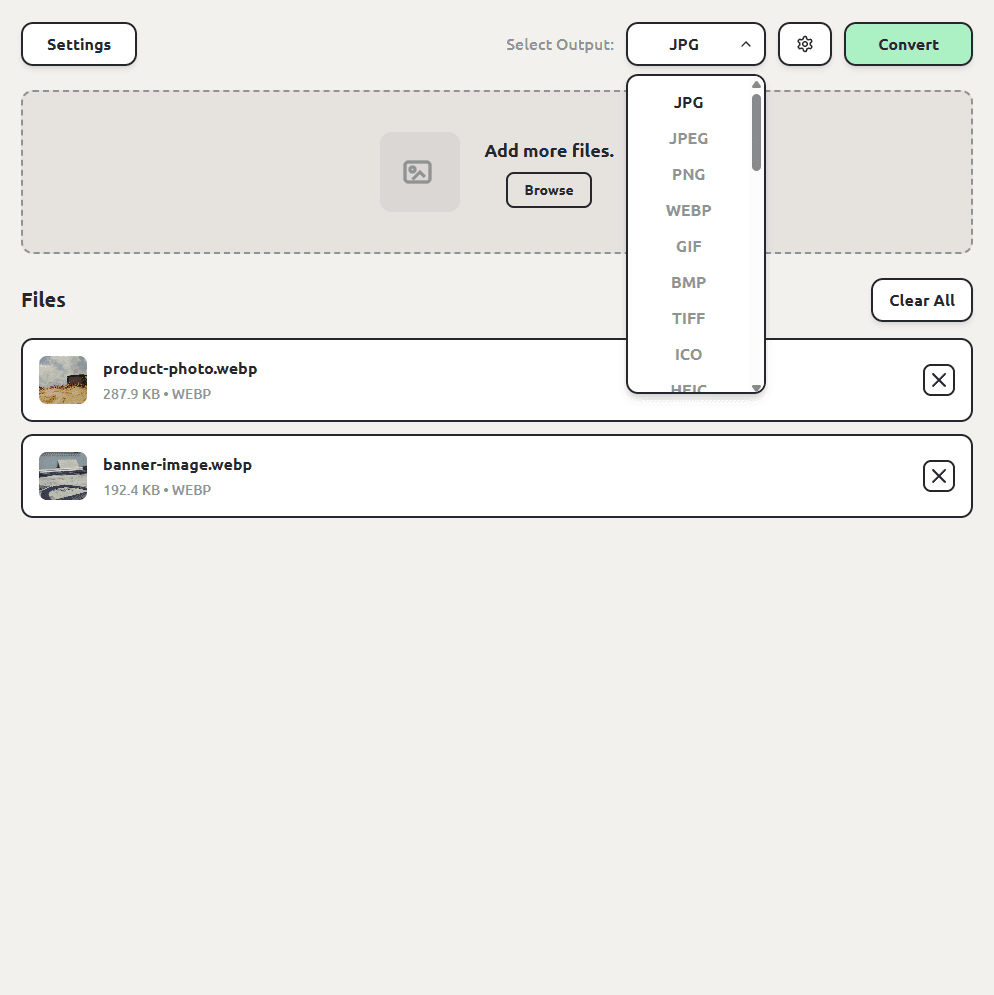
Choose JPG as the output format
Pick JPG from the format list. ConvertSave shows the formats that make sense for the files you dropped, so JPG is right there.
- 3
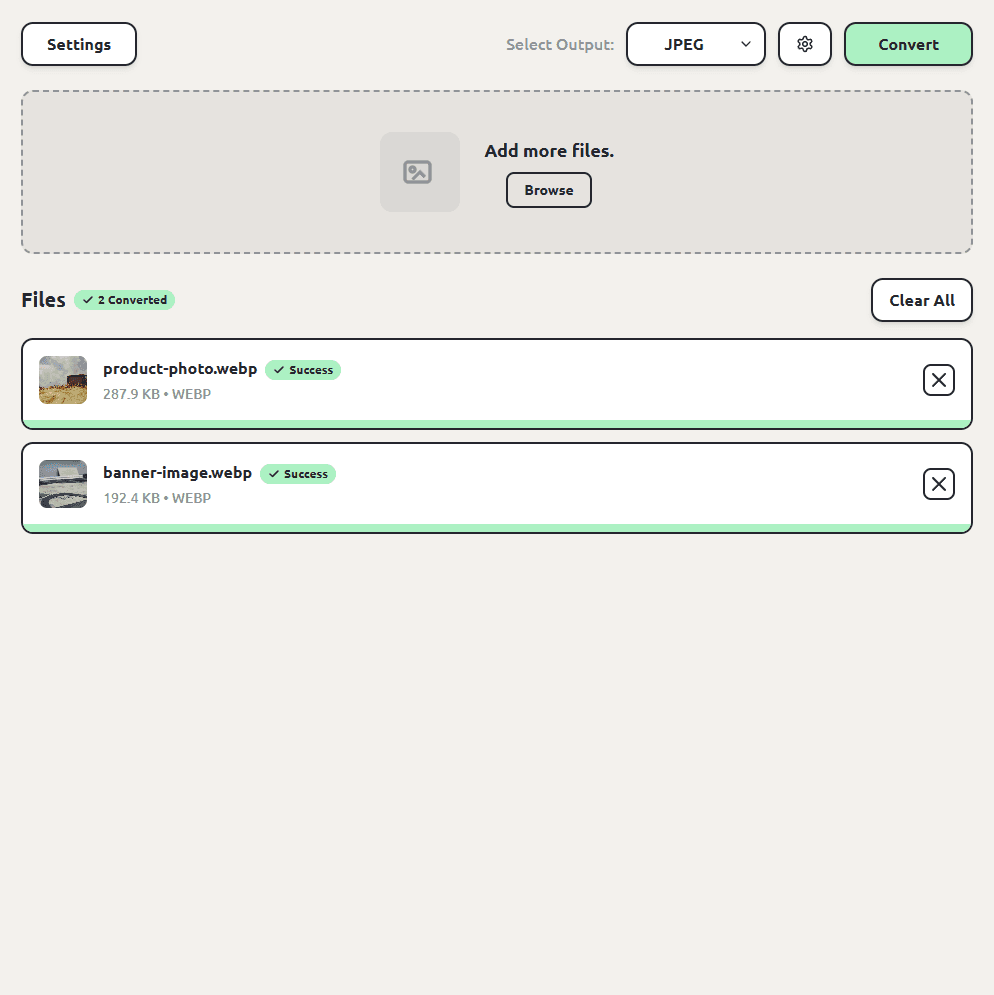
Click Convert
Hit the Convert button. Each JPG file is saved next to the original, so you don't have to hunt through folders to find your converted files. The originals are left untouched.
How to batch convert WEBP to JPG
Downloaded images tend to arrive in piles, so batch is the normal case. Select all the WEBP files, drag the whole set in, pick JPG once, and convert. Each JPG is saved next to its original with the same name. We've tested batches of up to a thousand files.
Need the other direction? JPG to WEBP
If you're putting images on a website, the conversion runs the other way: JPG to WEBP cuts file sizes noticeably at the same visual quality, which is why the web moved to it. Same steps, just pick WEBP as the output. JPEG files work identically.
WEBP vs JPG: what's the difference?
Both are lossy compressed image formats. WEBP is simply newer and more efficient, so the same picture fits in a smaller file. JPG's advantage is thirty years of software support.
| WEBP | JPG | |
|---|---|---|
| Age | 2010, made by Google | 1992, industry standard |
| File size | Smaller at the same quality | Larger |
| Opens in | Browsers and newer software | Everything |
| Best for | Serving images on websites | Sharing, printing, editing anywhere |
Is WEBP to JPG conversion safe?
The risk with converting WEBP images isn't the conversion itself, it's where the conversion happens. Free converter websites work by uploading your file to someone else's server. You usually can't tell who runs the server, where it is, or how long your file sticks around after the conversion finishes. For personal videos and photos that's a real privacy trade, and it's the reason so many of those sites are covered in aggressive ads.
ConvertSave does the conversion on your own computer. Nothing is uploaded anywhere. You can turn off Wi-Fi entirely and it still works, which is also the easy way to verify the claim. Your original file is never modified, and the converted copy is written right next to it.
Frequently asked questions
Does converting WEBP to JPG lose quality?
Both formats are lossy, so a conversion re-encodes the image. At ConvertSave's default quality the difference isn't visible in normal use. If you want a lossless copy instead, convert to PNG.
Why do so many downloaded images come as WEBP?
Websites serve WEBP because the files are smaller, which makes pages faster. Your browser is happy with that; the rest of your software often isn't, which is why converting to JPG is so common.
Can I convert WEBP to PNG instead?
Yes. The same steps work with PNG as the output, which is the better pick if the image has transparency or you want lossless quality.
Do my images get uploaded anywhere?
No. ConvertSave converts on your computer and works offline. Your images never leave your machine.
Is ConvertSave free?
There's a 7-day free trial with all features unlocked. After that it's $9/month, $60/year, or $129 once for a lifetime license that covers 3 personal devices on Mac and Windows.